As the lunar new year turns to the Year of the Horse (Bingwu), an ancient and familiar image once again emerges—the horse. In the millennia-spanning spiritual lineage of the Chinese people, the horse stands as a unique and vibrant cultural touchstone. It has borne witness to frontier beacons and Silk Road caravans, to the poetic spirit, the chivalrous boldness, and the deep sentiments of artists.
From the folk blessing of “taking the lead” to the life wisdom of “an old horse knows the way,” this creature galloping through the veins of culture embodies the Chinese reverence for speed, strength, and endurance. In literature, painting, and sculpture, the horse has taken on countless forms—the exhilaration of “a proud spring breeze hastening horse hooves,” the desolation of “an old horse on an ancient road in the western wind,” and the leisurely charm of “a riot of blossoms beguiling the eye, while shallow grass barely covers the horses’ hooves.”
Now, this horse that has galloped across millennia charges into 2026. People long to spur their mounts forward on a new journey, to break new ground, and to taste the triumph of “immediate success.” Yet, in their hearts, they also yearn for the ease of “letting the horse graze in the southern hills”—a return to a world more grounded in life itself.
As people constantly navigate between speed and pressure, seeking their place, the imagination of the horse reflects not only individual choices but also a collective contemplation of the era.
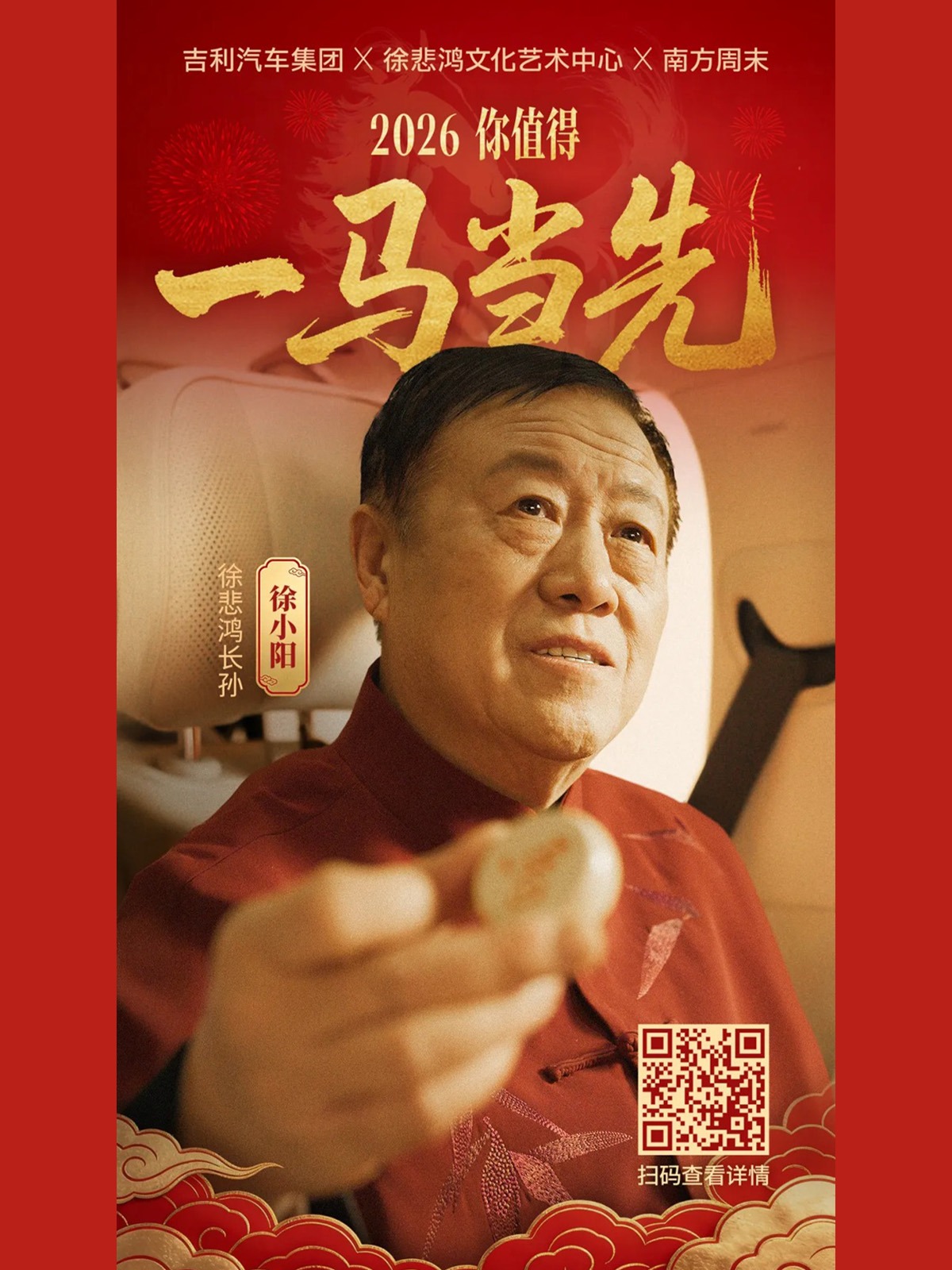
Geely Auto Group, together with the Xu Beihong Culture and Art Center and Southern Weekly, has launched the 2026 “Geely Chinese New Year” initiative. With the horse as their cultural lens, they invited Xu Xiaoyang, the eldest grandson of Xu Beihong, and writer Liu Shenlei (known as “Six God Lei”) to engage in a cultural dialogue about the horse, offering a more nuanced understanding of “moving forward”: the courage to take the lead, and equally, the wisdom to let oneself be. This is not only a festive cultural expression but also a response to the spiritual conditions of our time—a question posed to all: in a life where rushing has become the norm, how do we coexist with the horse within?
At the same time, Geely Auto Group invited Xu Xiaoyang to co-create a special Lunar New Year artwork titled “Galloping Geely” (literally “Horse of Good Fortune”). Rooted in the spirit of Xu Beihong’s “Galloping Horse,” the piece not only carries forward the artistic tradition of emphasizing vitality and form, but also connects its core essence to contemporary lifestyles.
Over its forty-year journey, Geely has forged resilience through cycles and strengthened its foundation amid change, holding firmly to the belief that only by staying steady can one go far. This work resonates deeply with Geely’s long-standing principle of “resilience, stability, and enduring progress.” Through the collaborative practice of the “Geely Chinese New Year” initiative, this corporate conviction has been brought into the broader fabric of social life. It is no longer merely a tenet of the automotive industry, but an attitude that every individual can embrace in the new year—a commitment to letting the heart find its direction, the feet find their strength, to pursue one’s passions with purpose, and to move steadily toward a lasting future.
Speaking of the Year of the Horse, Xu Xiaoyang has many plans. As an important inheritor and promoter of Xu Beihong’s artistic legacy, he shares his grandfather’s love for horses and deeply understands their significance in Chinese culture. He is often asked to inscribe calligraphy—”people love to write ‘immediate success’ or ‘the spirited vitality of the dragon and horse,'” he says.
Why is the horse so universally beloved? In Xu Xiaoyang’s view, the horse is not only one of the Chinese zodiac signs but also one of humanity’s closest companions across civilizations. Whether in migration, transport, labor, or even war, the bond between humans and horses has been forged through shared experience. This intimacy—enduring alongside humanity—transcends borders and cultures. “People all over the world love horses. It’s a universal sentiment,” Xu Xiaoyang notes.
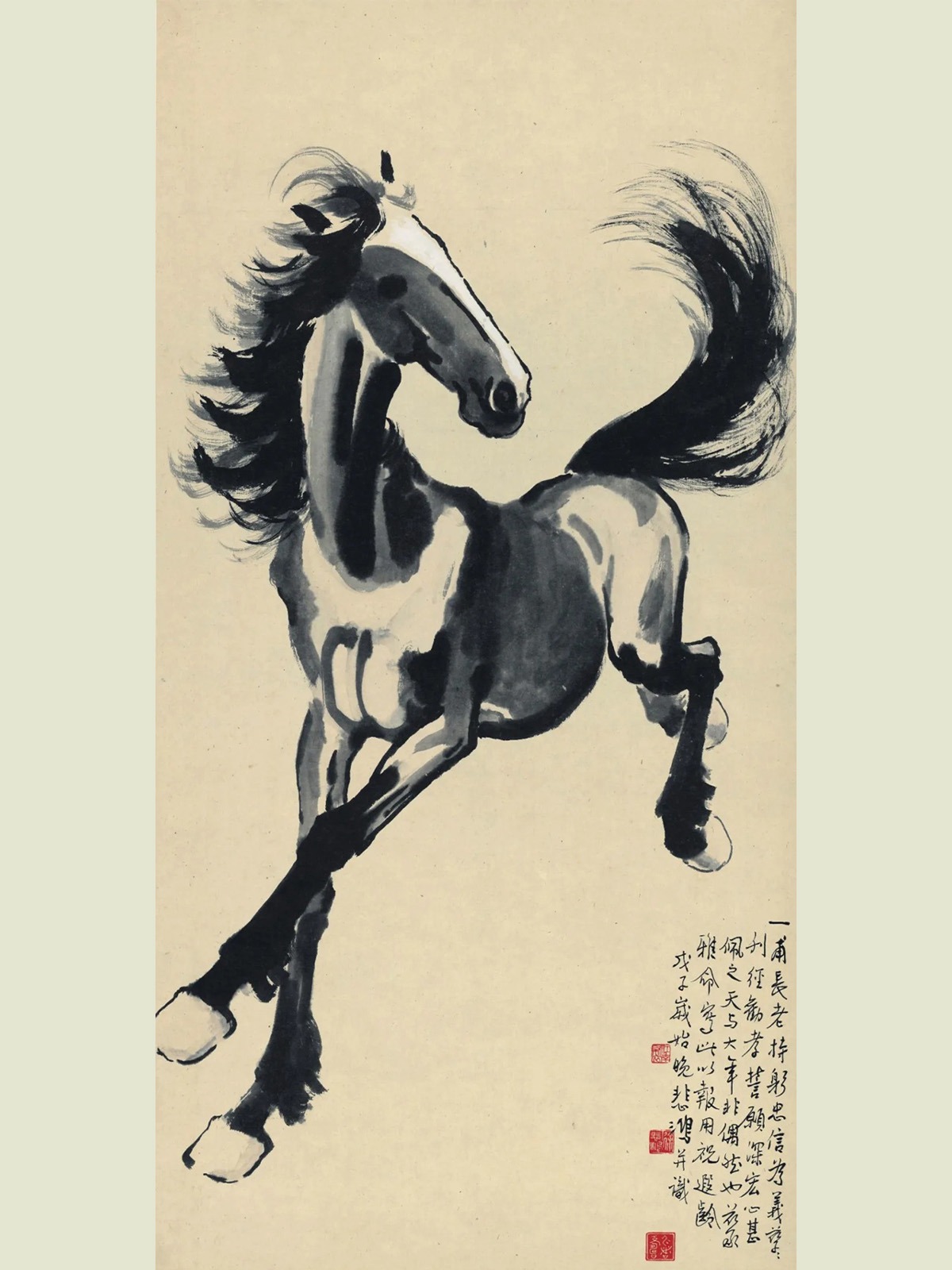
This love for horses, under the brush of his grandfather Xu Beihong, was elevated into a spiritual totem. The horse became a vessel connecting individual destiny, the currents of the era, and the spirit of the nation, holding within it a profound sense of devotion to one’s homeland. In Xu Beihong’s works, the horse is always depicted with head held high—even in stillness, it brims with the momentum of a gallop.
Speaking of the Year of the Horse, Xu Xiaoyang has many plans. As an important inheritor and promoter of Xu Beihong’s artistic legacy, he shares his grandfather’s love for horses and deeply understands their significance in Chinese culture. He is often asked to inscribe calligraphy—”people love to write ‘immediate success’ or ‘the spirited vitality of the dragon and horse,'” he says.
Why is the horse so universally beloved? In Xu Xiaoyang’s view, the horse is not only one of the Chinese zodiac signs but also one of humanity’s closest companions across civilizations. Whether in migration, transport, labor, or even war, the bond between humans and horses has been forged through shared experience. This intimacy—enduring alongside humanity—transcends borders and cultures. “People all over the world love horses. It’s a universal sentiment,” Xu Xiaoyang notes.
This love for horses, under the brush of his grandfather Xu Beihong, was elevated into a spiritual totem. The horse became a vessel connecting individual destiny, the currents of the era, and the spirit of the nation, holding within it a profound sense of devotion to one’s homeland. In Xu Beihong’s works, the horse is always depicted with head held high—even in stillness, it brims with the momentum of a gallop.
Xu Xiaoyang’s understanding of horses began at the Xu Beihong Memorial Hall.
“As far back as I can remember, our home had already become the Xu Beihong Memorial Hall.” That courtyard house, with its plaque inscribed “Former Residence of Beihong” by Premier Zhou Enlai, was both the setting of Xu Xiaoyang’s childhood memories and the spiritual sanctuary where he first encountered art. There were grapevines and wisteria in the courtyard, while the spirited, galloping horses in the exhibition hall quietly planted in a child’s heart the first seeds of an appreciation for strength and beauty.
Through years of immersion, Xu Xiaoyang gradually developed a deeper understanding of the horses his grandfather painted. “When he painted horses, he was confiding in the heavens—using the horse as a vessel to pour out the landscapes within his heart and the breath of his era to the universe.”
This “confiding” reached its most intense period during the War of Resistance. In 1941, during the Second Battle of Changsha, Xu Beihong was in Southeast Asia holding exhibitions to raise funds for the war effort. As the battle raged and news was cut off, he painted Galloping Horse in a state of anxiety and indignation. This painting is Xu Xiaoyang’s favorite among his grandfather’s works. In it, the horse is depicted with all four hooves in the air, neck held high, mane flying—each brushstroke infused with the anguish of the era and the rallying cry of a nation. The galloping horse, embodying an indomitable spirit, seems ready to break through the paper itself.
Yet beyond the relentlessly galloping horses in Xu Beihong’s art, Xu Xiaoyang also spoke with deep emotion about a detail that is often overlooked. He pointed to the profound meaning within some of the paintings where the horse is depicted looking back. “It’s like a warrior, before heading into battle, casting one last glance back at the mountains and rivers of his homeland, at his fellow villagers. Knowing the road ahead is perilous, knowing he may never return, he still charges forward—not despite the danger, but with even greater resolve.” Xu Xiaoyang reflected on the line from Du Fu’s poetry that his grandfather often inscribed on such works: “Standing tall, gazing into the vast beyond.” The act of looking back, he explains, is rooted in a complex interweaving of responsibility toward one’s homeland, national integrity, and personal choice.
Where does the strength for this kind of “taking the lead”—imbued with such intense emotion and a sense of mission—originate? In Xu Xiaoyang’s view, it is inseparable from Xu Beihong’s relentless pursuit of artistic mastery. “What is the most difficult part of painting a horse? It’s capturing its spirit and vitality!” Yet to capture that intangible “spirit,” one must first achieve the most solid grasp of “form.” Xu Xiaoyang notes that his grandfather almost never painted the eyes of his horses. Instead, he relied on structure, conveying expression through a freehand approach. Behind each stroke lay countless refinements of bone, muscle, and movement. In the simplest brushwork, he embedded the fullest essence. “Everything was captured in a single stroke,” Xu Xiaoyang marvels. “One more stroke would be too many; one fewer, not enough.”
This dedication to “craft” reflects Xu Xiaoyang’s understanding of striving in life. In Geely Auto Group’s New Year’s promotional film for the Year of the Horse, Xu Xiaoyang says, “If you want to achieve immediate success, you must put in the work now, in the details.” This sentiment weaves together his own life experience with the collective mood of society.
Facing the uncertainty and pressure that many people experience today, he expresses deep empathy. “Whether you choose to take the lead or let yourself be,” he says, “the most important thing is to first ‘understand yourself.’ Take the lead, but don’t get caught up in meaningless comparisons. Keep moving because you’ve found what you truly love.”
He recalled that when his grandfather Xu Beihong was just 23 years old, he resolved to reform Chinese painting, proposing the principle: “Preserve what is excellent in the ancient methods, reform what is not, and incorporate what can be adopted from Western painting.” This courage to “take the lead” stemmed from a profound understanding of both Eastern and Western art—knowing clearly what he wanted to do and what he was capable of achieving. At the same time, Xu Xiaoyang noted that if one’s strength is insufficient, “letting the horse graze in the southern hills” to rest and regroup is also a valid choice. “Society is progressing,” he said. “There is room for all kinds of attitudes toward life. But a temporary ‘lying flat’ should never be an excuse to give up just because of a small setback.”
Whether one chooses to “take the lead” or “let oneself be,” Xu Xiaoyang emphasizes an underlying psychological strength. “Life is long,” he said. “Each time you overcome an obstacle, you make progress. Each time you solve a problem on your own, you mature.” He observed that Xu Beihong’s own life was full of hardships—he suffered poverty and illness while studying art, endured displacement during the War of Resistance, and accumulated debt to preserve national art treasures. Yet he always managed to break free from seemingly hopeless situations, because the horse within him was always running toward a clear direction: to contribute to China’s art education and artistic renaissance.
In Xu Xiaoyang’s view, this ability to maintain resilience in the face of adversity is a quality far more valuable than any momentary sprint. In his eyes, true “taking the lead” is inseparable from this “resilience”—the power that emerges when one has identified the right direction, allowing one to both master the finest details and withstand great pressure. It is a strength of immense force.
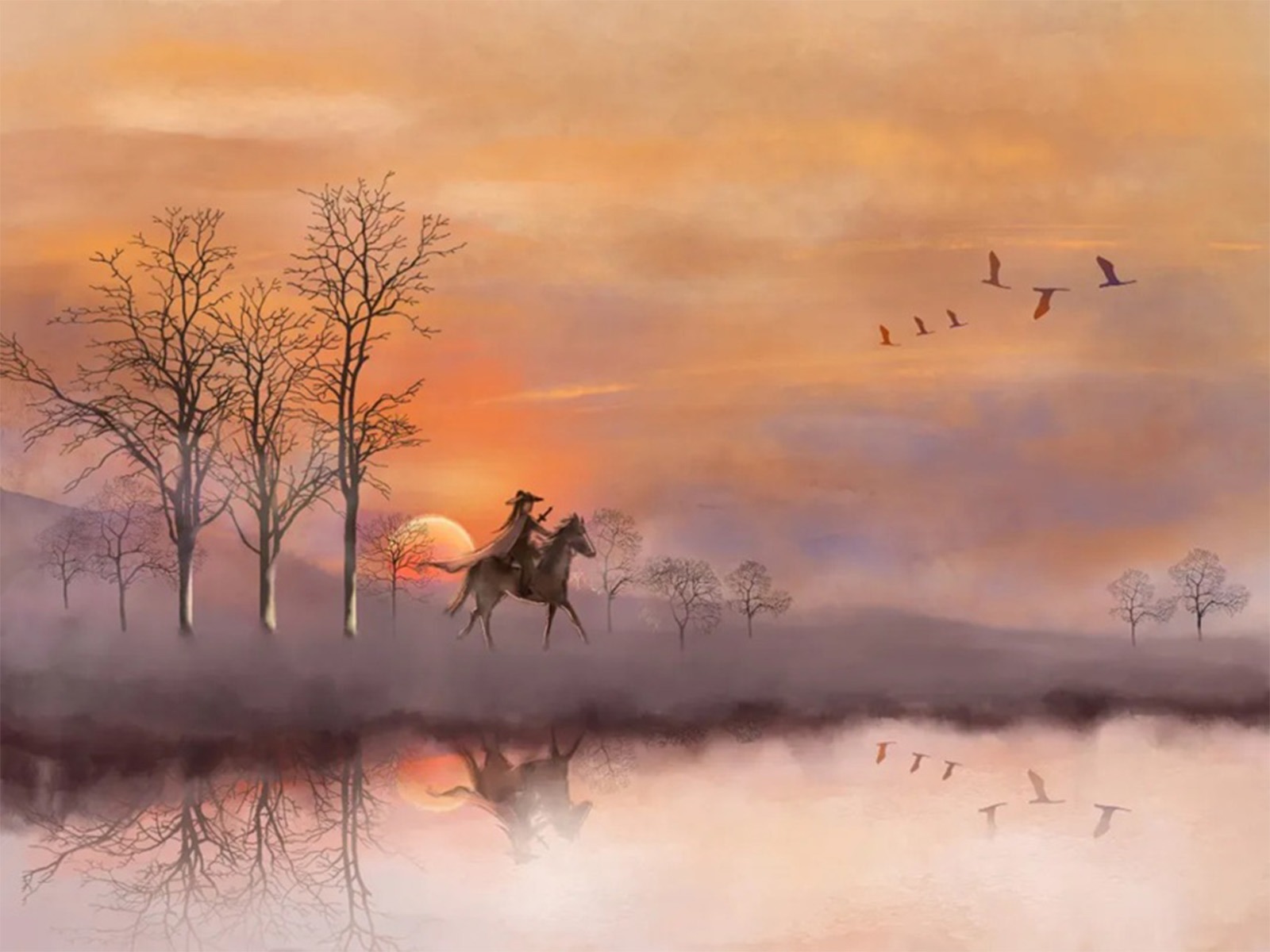
“The nature of the horse allows one to travel farther.” (Photo: Visual China Group)
In the imaginative world of writer Liu Shenlei (known as “Six God Lei”), the horse is the most frequently recurring image in martial arts novels, and serves as a perfect metaphor for the idea that “life is an open field.” “The nature of the horse allows one to travel farther than any other,” he explains. “It best embodies the spirit and essence of the chivalrous hero.”
He evokes the Ferghana horse of Guo Jing, a character in Jin Yong’s novels—a warhorse that fights alongside its master in life-and-death battles, yet also serves as a leisurely companion, carrying Guo Jing and Huang Rong along the lakeshore at dusk. The two states of a single horse perfectly mirror the two dimensions of a hero’s life: the relentless pursuit of duty and the freedom to savor life itself. As for Yang Guo, at his lowest point, when he saw no future ahead, he encountered an emaciated, mistreated horse at a market. He bought it on a whim, never expecting that this seemingly weak creature would turn out to be a steed capable of covering a thousand miles.
In Liu Shenlei’s view, this “skinny horse” becomes a vivid metaphor for self-redemption. “One should never give up on oneself,” he reflects. “Often, our own potential remains hidden even from ourselves.” In 2026, amid the current cycle of uncertainty, people are in need of this kind of self-belief and collective affirmation—one that stirs the spirit, reawakens the “purest fire of the heart,” and restores faith in one’s own latent potential.
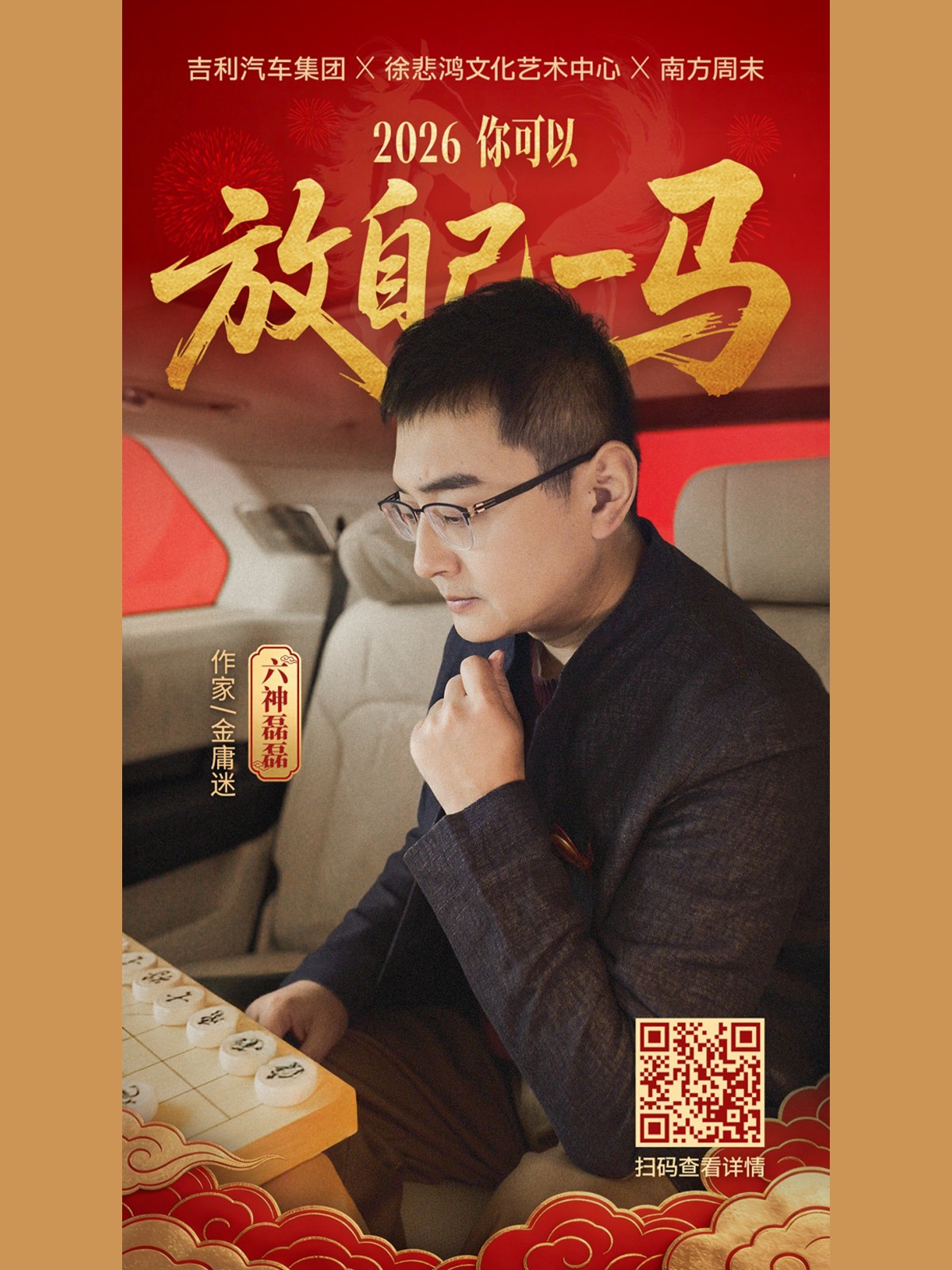
From the martial arts world to reality, Liu Shenlei, with his keen insight as a writer and former journalist, perceives the subtle shifts in the spirit of the times. He recalls that when he first entered the workforce, society was pervaded by a widespread ambition to “achieve great things and make remarkable accomplishments.” Today, however, the collective mindset is far more complex and diverse. Much of the pressure on young people, he observes, stems from “systemic uncertainty” and the collision of values and voices in an age of information overload. “On one hand, they’re told to strive forward; on the other, to let themselves be. One voice says if you don’t push hard, you’ll be left behind; another says striving is just falling into a trap. Young people don’t know which way to turn. Every argument sounds reasonable, and in the end, they’re left lost and confused.”
As traditional, singular paths to success are broken apart and a multiplicity of values floods in, the act of choosing itself becomes a burden. Yet Liu Shenlei believes that this same reality also presents a unique opportunity unique to this era.
“The rise of self-media has infinitely broadened the definition of ‘talent,'” he explains. He notes that in the past, people considered writing well or shooting good videos as talents, but being funny, having a knack for life, or being introverted were not seen as advantages. Today, a blogger with an eye for the beauty of plants, a video creator who can interpret history through the lens of gaming, a girl who wins hearts and encouragement simply by being genuinely nervous on camera—all of these can become ‘talents’ that allow one to be seen, recognized, connect with others, and build a life. “This era is full of opportunities for young people. The stage is big enough, and there are plenty of channels. The key is to find what makes you shine.” Of course, finding it is only the beginning; it takes persistence—the willingness to refine it in solitude, through long stretches when no one is applauding.
As for how to choose between “taking the lead” and “letting yourself be,” he traces the answer back to whether one harbors true “passion.” A few years ago, when short-form videos swept the content world with the “golden 3 seconds” theory, everyone around him urged him to adapt and embrace the fast-paced format. He tried, but it left him feeling painfully “inauthentic.” “It was extremely uncomfortable,” he admits. Forcing conflict, pushing extreme viewpoints, sacrificing completeness and depth for speed—it all ran counter to the way he was best at expressing himself and what he truly enjoyed. “The premise for taking the lead is passion,” he says. “The moment to let yourself be comes when you find yourself doing something that goes against your true nature, something that makes you deeply miserable and at odds with yourself.”
So he chose to “let himself be”—swimming against the tide, focusing on creating the 20-to-30-minute long-form videos he loves and does best, slowly discussing Jin Yong’s novels and Tang dynasty poetry. The numbers were modest at first, but he persisted. This seemingly “counter-current” perseverance eventually won him hundreds of thousands of viewers willing to listen with patience. For him, this “letting oneself be” was not giving up; it was precisely the way to move forward better—a courageous return to and steadfast commitment to a rhythm that suits him, after refusing to be alienated by external standards.
“When everyone is charging in the same direction, being able to stop and ask, ‘Is this truly the direction I want to go?’ requires not only courage but also a clear-eyed self-confidence. The core of it is simple: if you can’t make sense of the trends, at least make sense of yourself. Playing to your strengths is far more important than blindly following the crowd.”
So, when should one gallop forward, and when should one let the reins go loose? Liu Shenlei turns to classic characters from Jin Yong’s novels for insight. Both are supreme martial artists, yet their paths diverge. Ouyang Feng spent his life consumed by the obsession of becoming the “greatest martial artist under heaven,” ultimately descending into madness, his own skills turning into poison that consumed him from within. Hong Qigong, in contrast, loved martial arts, but he also loved fine food, lively company, and a life of ease. He appeared lazy and untamed, indulging in pleasures, yet never allowed any desire to rule him. Once, because of his gluttony, he caused a delay in an important matter, but at the critical moment, he cut off his own finger to make a vow—showing that when it truly mattered, he could make the ultimate sacrifice. “For Hong Qigong,” Liu observes, “desires were merely ornaments that adorned his life. He never allowed them to become shackles that controlled it. His character remained true to itself to the very end—and that is the highest level of mastering desire.”
Knowing how to distinguish between “passion” and “obsession,” knowing when to take the lead for a greater cause and when to let the reins go loose for the sake of life itself—in Liu Shenlei’s view, the reins of life ultimately must “follow one’s own heart.” Speaking of the newly arrived Year of the Horse, his plans are clear and resolute: resolutely let go of the things he is not truly passionate about, shut out the irrelevant noise, and focus all his energy on completing two book manuscripts—one on Dream of the Red Chamber and the other on Tang poetry. “This, too, is a way of letting myself be.”
Though they come from different generations and fields, the shared understanding between Xu Xiaoyang and Liu Shenlei is clear and compelling: whether one chooses to “take the lead” or “let oneself be,” both must be grounded in the fundamental prerequisite of “knowing oneself”—along with the dedication to deep, sustained effort and the resilience to navigate setbacks.
This profound grasp of balance and tension also lies at the heart of the collaboration between Geely Auto Group and the Xu Beihong Culture and Art Center. The reflections of the two speakers resonate deeply with the spirit championed by Geely: “Resilience Carries Us Far,” creating a connection that spans across domains.
Resilience echoes what Xu Xiaoyang emphasized—the kind of steadfast dedication and capacity to endure pressure that Xu Beihong embodied: once he had found his path, he never wavered, no matter the obstacles. It also reflects Geely’s approach in navigating the century-long transformation of the automotive industry—pursuing a dual-path strategy of both internal combustion and electrification in line with its own strategic vision, neither rushing ahead recklessly nor falling behind, steadily building its strength through the complexities of the market.
Carrying forward aligns with the clarity Liu Shenlei spoke of—the ability to discern one’s true direction amidst a flood of trends. It symbolizes Geely’s commitment to continuous innovation and steady progress once its direction is set.
Far represents the shared vision: only by moving forward with a clear understanding of oneself and one’s environment—with both composure and resilience—can one transcend cycles, advance steadily, and arrive at a broader and more expansive future.
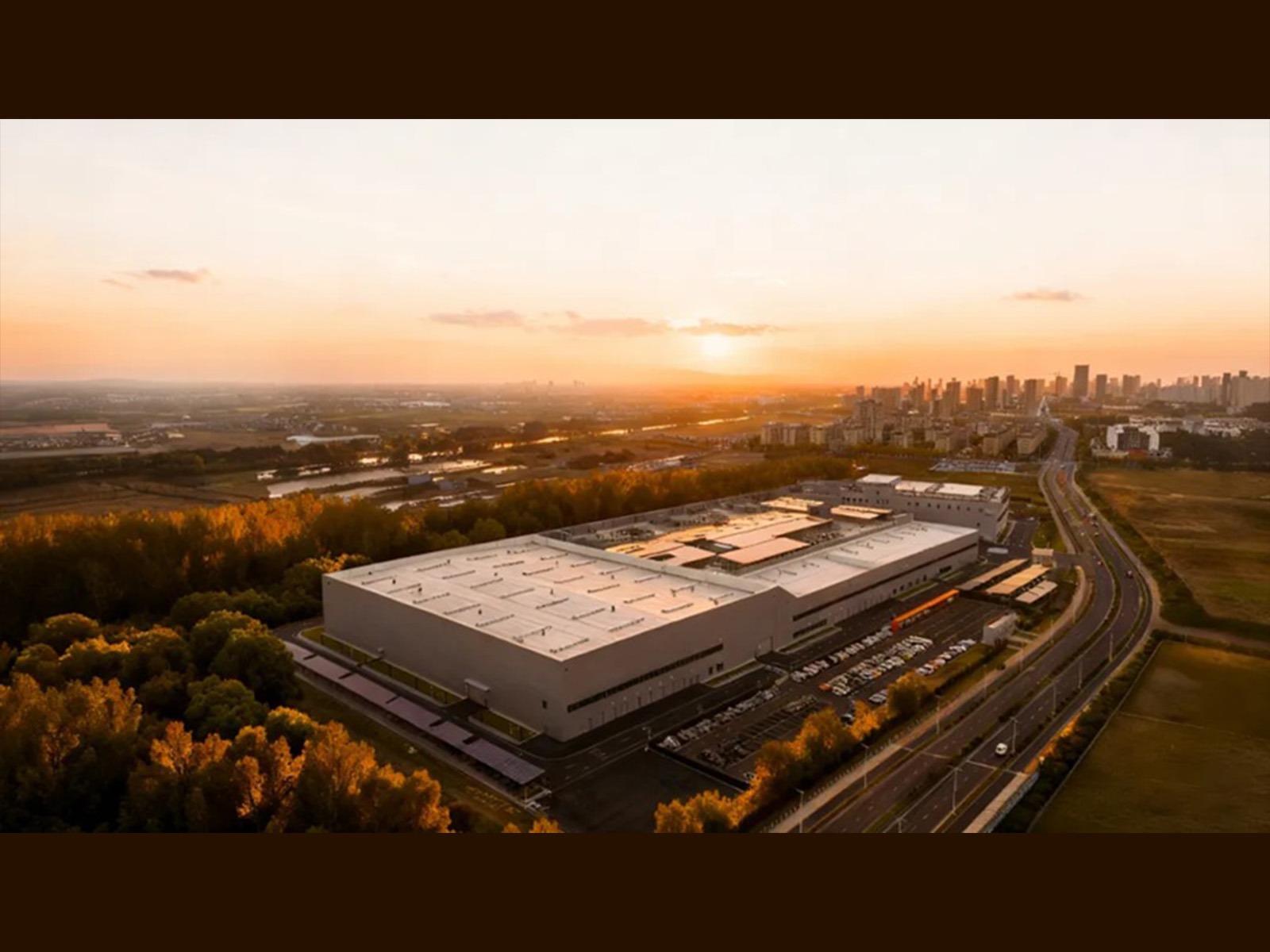
In 2025, the Geely Global Safety Center, built with an investment of over 2 billion yuan, was officially inaugurated. (Photo: Geely Auto Group)
On February 24, 2026, the first day of work in the Year of the Horse, Geely Auto Group CEO Gan Jiayue set the tone for the year ahead with a New Year message titled “Resilience, Stability, and Enduring Progress: Gathering Strength to Move Forward.”
In this message of over two thousand characters, the word “value” appears no fewer than nineteen times—referring to value for users, value for the industry, value for society, and the value of the symbiotic relationship between the company and its employees. This repeated emphasis sends a clear signal: Geely is proactively shifting its evaluation framework from a “scale-oriented” approach to a “value-oriented” one. Scale may create a large company, but only value can lead to greatness.
Looking back at the automotive market in recent years, competition for market share has grown increasingly fierce. As price wars and battles over concepts flood the industry, companies are easily swept along in the rush. Against this backdrop, Geely has established a clear strategic consensus: resolutely reject involutionary and vicious competition, and unwaveringly pursue a path of connotative, sustainable development.
The “connotative, sustainable development” that Gan Jiayue emphasizes is, at its core, a form of strategic self-discipline—rejecting destructive internal competition, shifting the focus of competition toward technological depth, quality systems, and user experience, and prioritizing long-term value over short-term scale. This is, in a sense, the corporate equivalent of “holding the reins.” This positioning is not conservative or retreatist; rather, it reflects a deep understanding of industrial dynamics and corporate mission forged over forty years of market experience, and it represents Geely’s core “right path” in navigating the century-long transformation of the automotive industry.
The automotive industry has never been a short sprint; it is a long-distance race that tests endurance and composure. True strength lies not in being ahead for a moment, but in maintaining direction and steady rhythm in the face of turbulence. It is not about refusing to move forward—it is about first asking: are we racing toward fleeting traffic, or toward lasting value?
The nineteen mentions of “value” outline three coordinates for Geely. For users, value means solving real problems, not merely stacking up specifications. For the industry, value means rejecting involution and reshaping the rules of competition. For society, value means ensuring that the growth of the company and the growth of its employees move in harmony. When a company at its scale repeatedly asks itself, “Are we still creating genuine value?” it signals that it is no longer content to be just a large enterprise—it is approaching the standard of greatness.
In 2026, China’s automotive industry is navigating a critical transformation, with many players seeking to move beyond low-price competition and upgrade toward value. Geely’s New Year message serves not only as a corporate blueprint but also as a guide for the industry: true competition is not about running the fastest, but about moving forward steadily, standing the test of time, and creating real value with both feet firmly on the ground.
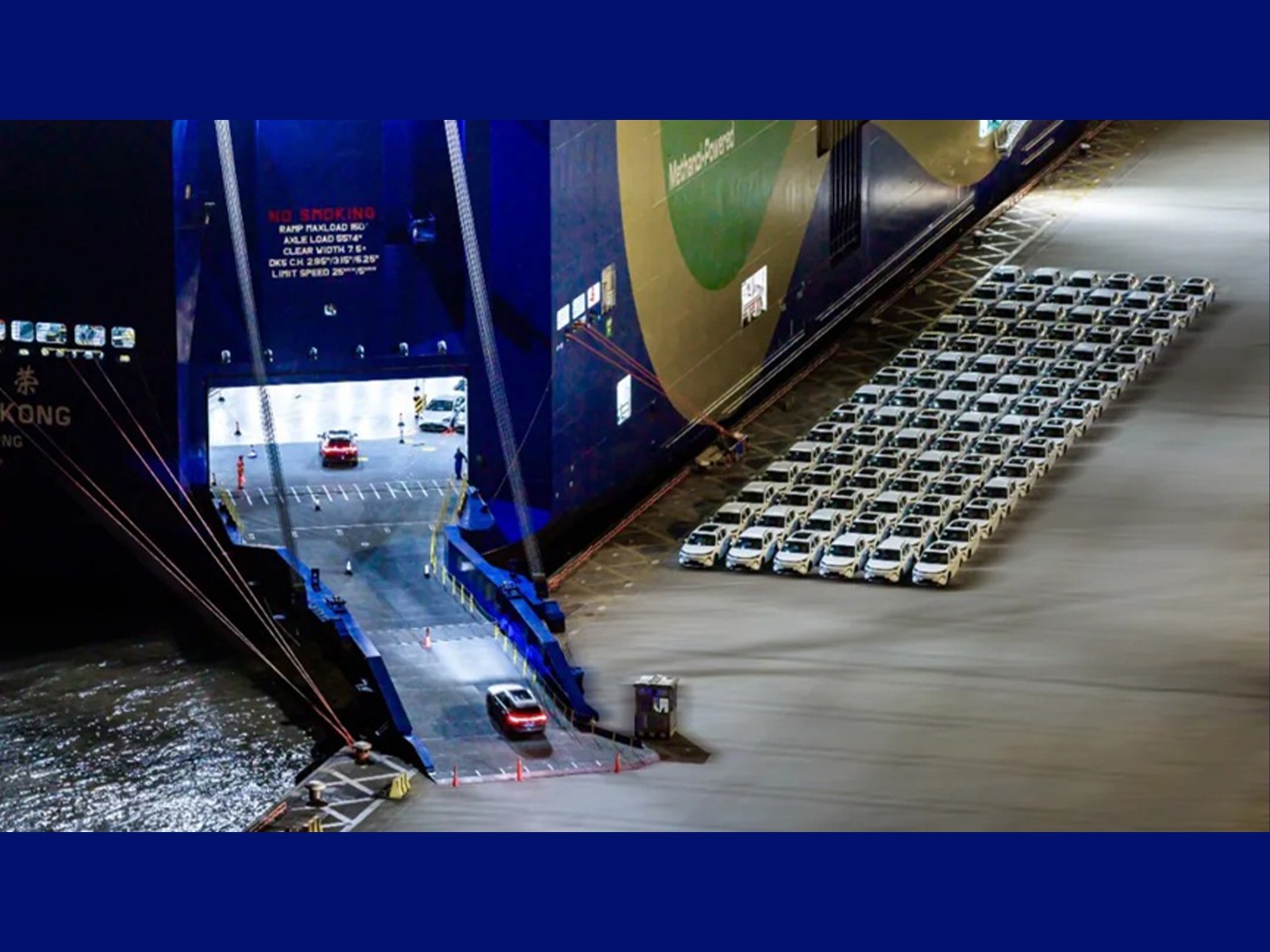
Over a thousand Geely Galaxy Starship 7 EM-i vehicles assembled and shipped, marking a new chapter in the global expansion of China’s new energy vehicles. (Photo: Geely Auto Group)
Looking back at Geely’s forty-year entrepreneurial journey—from a pioneer in private automobile manufacturing to a global industry leader—the market landscape has undergone repeated transformations, and technological waves have risen and fallen. Yet through it all, one core commitment has remained unchanged: “doing things that create value.” At this milestone of forty years, Geely’s choice to emphasize “value” at a moment when the instinct might be to sprint is, in fact, a recalibration of direction for the future. True progress is not just about speed, but about direction and composure. True growth is not just about scale, but about substance validated by time. When passion is clear, take the lead; when the environment grows noisy, hold to the right path. Value is the reins that one does not easily let go.
In 2026, the Year of the Horse (Bingwu), we offer the blessing “Galloping Geely” (literally “Horse of Good Fortune”), wishing that we may all find a better way to settle the one and only “horse” within our hearts. Geely believes that the world is vast enough to hold ten thousand horses galloping, and just as vast enough to hold one person strolling leisurely with one horse. What moves us most has never been a uniform gallop, but that fine steed called “the self”—with steady hoofbeats and a composed gait, moving at its own pace, always walking its own path.
May everyone always hold their own reins firmly, navigate with ease, keep their hearts open to the wide world, and journey forward on a road without bounds.

Xu Beihong’s life was deeply intertwined with the fate and rise of his nation. He embodied great patriotism, selfless dedication, relentless artistic innovation, and a keen eye for nurturing talent. His legacy reflects an unwavering spirit of independence, moral integrity, and enduring inspiration. (Engraved in the central hall of the Beijing Xu Beihong Memorial Hall)
Xu Beihong was a leading Chinese artist and art educator, known as the “Father of Modern Chinese Painting.” He was the first president of the Central Academy of Fine Arts and chairman of the China Artists Association. His works, including Tian Heng and His Five Hundred Followers 《田横五百士》, Waiting for the Deliverer 《徯我后》, and The Foolish Old Man Removes the Mountains 《愚公移山》, laid the foundation for modern Chinese oil painting with their unique blend of Chinese style and Western technique.
He believed art should reflect real life and combined Chinese traditions with Western methods to create a new, influential style. Xu Beihong not only produced many masterpieces but also trained a generation of outstanding artists, shaping China’s modern art education system. His efforts promoted Chinese art worldwide, leaving a lasting legacy.